Busted Halo
Loading

Column: What Works

Practical tools for your personal spiritual life

Click this banner to see the entire series.

February 2nd, 2012

Re: Why I Hate Religion, But Love Jesus

  • (28)
  • Follow us:

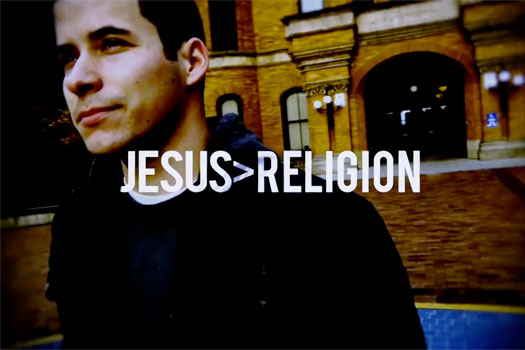
As the viral video “Why I Hate Religion, But Love Jesus,” by Jefferson Bethke, approaches 18 million views, I will add my response into the clutter. I’ve seen pro-life responses. I’ve seen Catholic exceptionalism responses. I’ve seen atheist and non-Christian responses that agree but then have their own conclusions. I am not interested in getting into theological debate, or in driving wedges between people. I want to make a simple point. It’s the same point I often make to friends who say they’re spiritual but not religious. And to some atheist friends right after they’ve explained why they don’t believe in God.

It is this: What you are calling religion is not what I call religion, and it is not the definition of religion. The God you blame or are angry at or don’t believe in is not my God. You’re experience is real, without a doubt. And I honor that. You are speaking from hurt. Your encounters with religion, as given to you by parents and authority figures, were messed up. And there’s no question that Jesus devoted a lot of attention to denouncing those types of religious behavior and expression. But the religion that hurt you or disappointed you is not all organized religion.

You’re experience is real, without a doubt. And I honor that. You are speaking from hurt. Your encounters with religion, as given to you by parents and authority figures, were messed up. And there’s no question that Jesus devoted a lot of attention to denouncing those types of religious behavior and expression. But the religion that hurt you or disappointed you is not all organized religion.

What we call a religion is made up of three things: belief that there’s something more than this material world; a set of ethics and moral guidance; and rites and shared rituals. Different organized religions put emphasis on one or another of the three, but each is a mixture of them all. Ritual without the spiritual dimension is bereft and can be dangerous. Law without the spiritual dimension is at best difficult to maintain, at times punitive and harsh, and can be offensively hypocritical. What you’re railing against is an experience of organized religion that was empty ritual and harsh hypocritical law. So you’re not criticizing religion; you’re criticizing an expression of religion that doesn’t live up to the definition. I’ve had encounters with religious expressions like that. But I also know beautiful, amazing expressions of religion that are overflowing with love.

While a religion in the broad sense is that combination of spirituality, ritual and law, a religion on the ground is made up of people — fallible, silly, broken people. This is slightly tricky ground, I admit. I’m saying that a group of people who come together to worship God collectively is a divinely inspired thing, and at the same time a jumble of flawed humans who can individually do profoundly stupid stuff.

If individuals do hypocritical or hateful things in the name of a religion, that doesn’t make the religion hypocritical or hateful. Even if the institutional expression of the religion, a church bureaucracy, does profoundly stupid things, that’s still people doing them. We can debate over how much or how little hierarchy a religion should have, but it’s always made up of people. And it is not when leaders are imperfect but when they lack the humility to remember they’re flawed humans that much of the trouble comes.

One more point — an obvious one that some of those who’ve responded have already brought up: it’s easy to mention the wars and division and oppression that have occurred in the name of religion. But if you’re going to try to blame all that stuff on religion, then you also need to acknowledge all the charity, and the abolition of slavery, and the civil rights movement, and the billions of acts of kindness and compassion inspired by religion.

So, of course there’s lots wrong with organized religions. But there’s lots right too. People like to have black and white answers, embrace some things unquestioningly and denounce others blindly. But that’s not the world. The world is a messy place. And that’s part of what’s so awesome about it. I celebrate your obviously passionate faith. And I agree with many of your complaints. But I choose to focus what energy I have on building up what’s beautiful in love.

  • (28)
  • Follow us:
The Author : Phil Fox Rose
Phil Fox Rose is a writer, editor and content lead based in New York. He writes the What Works personal spirituality column at Busted Halo and is assistant coordinator for the New York City chapter of Contemplative Outreach, helping promote centering prayer, which has been his contemplative practice for over 17 years. Phil has also been a political party leader, videographer, tech journalist, punk roadie, software designer, sheepherder, stockbroker and downtempo radio DJ. A common thread is the process of learning about stuff, figuring it out and then sharing that understanding with others. Follow Phil on Facebook here. Or on Twitter here. philfoxrose.com.
See more articles by (83).
28 comments about “Re: Why I Hate Religion, But Love Jesus”
Jane -- February 2nd, 2012 at 11:47 am

Phil- a deftly written response to the ” Why I hate Religion” notion. Your points are well taken, and provide such a positive view point. I completely agree…Religion is complicated and sometimes we see the frailities of humans on display in any hierarchy…and the Church is no exception. Yet choosing to focus on and build up all that is good- and embrace the love and goodness that Religion and yes- The Church- have to offer is a recipe for joy in the midst of our faith. Thank you for sharing your insightful thoughts. Jane K.

Nora -- February 2nd, 2012 at 12:17 pm

Where’s the church, who took the steeple?
Religion is in the hands of some crazy-ass people
Television preachers with bad hair and dimples
The god’s honest truth is it’s not that simple
Its the Buddhist in you, it’s the Pagan in me
Its the Muslim in him, she’s Catholic aint she?
Its the born again look it’s the WASP and the Jew
Peace, Rasta-man, I aint gotta clue!

~Jimmy Buffett

The things that are good about religion and religious people are good in ALL religions, religious people. The things that are bad about religion and religious people are bad about ALL religions, religious people.

I am so over this SBNR v. Doctrine/Dogma stuff.

God is SO much bigger than all this pettiness.

Amie -- February 2nd, 2012 at 5:12 pm

Thank you, Phil!

Sally -- February 2nd, 2012 at 6:31 pm

The word ‘religion’ comes from the Latin ‘religio’ meaning to be ‘rebound’. We are rebound to Jesus through his life, teaching, death and resurrection. Thus, St. James’ statement in his epistle regarding religion (James 1:27) makes sense to the Christian as it describes the life of one who is indeed rebound to and following Jesus.

Sally -- February 2nd, 2012 at 6:35 pm

Or, rather, we are rebound to GOD through the life, teaching, death and resurrection of Jesus.

Harry -- February 2nd, 2012 at 10:15 pm

Actually, the notion that one needed to be re-bound to G-d has never made much sense to me. What kind of G-d from which all creation sprang could ever be separated from that creation?

I appreciate the definition of religion offered here. I think it’s pretty much on target. I would add the experience of human beings and the traditions which have calcified around the three elements you mention are important functional aspects as well. The prophetic tends to arise from the experiential and frequently challenges the calcified traditional aspects.

BTW, I appreciated the hint of critical approach to religion in the original video even if it ended up reverting to automaton evangelicalism before it got finished.

ruth housman -- February 3rd, 2012 at 2:13 am

“Bound” for Glory: I just read Harry’s comment and so totally agree with his very first two sentences. G_d is not separate from Creation. This means we are part of that greater whole, and that we carry Divinity within.

The task is to separate the wheat from the chaff, meaning it could be, everyone is G_d speaking, and not in metaphor, but really, truly. Our job is to take those with words of hate, divisiveness, and mean and cruel words, and acts, and not embrace those things. We need to do what Ruth did, what the ancients did in the fields that were allocated to them, and to weed out the POV, Poverty of Ideas, that Point of View, from what is golden, the wheat, what rises within us all, that One Song, that is about LOVE, the compass in compassion itself.

I totally agree that so much in religious communities of all kinds is about working to change the world in positive ways, about gifting each other. And I also see, that atheists do keep us honest in that terrible things have been done in the name of religion.

I do deeply believe it’s ALL G_D. To see this perhaps takes profound journey, of SOUL.

Jason -- February 3rd, 2012 at 8:15 am

Great piece! I love this!!!! Thank you SO very much for sharing it with us all.

Angie -- February 3rd, 2012 at 11:51 am

This is so perfectly written and spot on. I wish I could just carry this with me for all the times this debate comes up in my life (which seems far too often). Thank you so much for writing this.

Bob -- February 3rd, 2012 at 5:10 pm

“Good” is mentioned in several of the foregoing remarks.
My question is what is good, or who is good?
Then when good is defined……how good is good enough to ensure a right relationship with God?

Joe -- February 4th, 2012 at 12:24 pm

The Church is not a museum for saints, it’s a hospital for sinners. Every century has its Judases and its saints. What’s amazing is that the doctrine and sacraments of the faith remain the same and consistent, even if some people fail to respond to grace and make a mockery of their religion. The Catholic Church should have imploded a long time ago, yet it has outlasted ancient empires and kingdoms despite our best efforts to destroy ourselves. That’s empirical evidence that a Savior is at work.

Teresa -- February 4th, 2012 at 9:14 pm

An excellent response. And so human. Thank you so much for writing this very God-inspired piece. May God continue to bless you and inspire your writing.

Jann Holladay -- February 6th, 2012 at 1:11 pm

Religions are like the people in them, both horridly flawed and amazingly beautiful. You made your point well.

Michelle -- February 11th, 2012 at 1:06 am

I like this very much and speaks what’s on my heart, thank you

Julie Hagan Bloch -- February 13th, 2012 at 7:57 pm

You wrote:

“If individuals do hypocritical or hateful things in the name of a religion, that doesn’t make the religion hypocritical or hateful. Even if the institutional expression of the religion, a church bureaucracy, does profoundly stupid things, that’s still people doing them.”

Good points, but how about this: apply the same logic to organizations you dislike. For the word “religion”, substitute, for example, “Planned Parenthood”. Just saying.

Verita Lesar -- February 16th, 2012 at 4:32 am

What you are saying makes sense…and I acknowledge this coming from a Catholic upbringing and having my own reservations about certain things… I do believe that a “church” is made up of people..so its people that we find a problem with and not God..or the word(Bible). :)

bryan hardy -- February 16th, 2012 at 6:41 am

Religion = nth percent relationship with God and umpteen percent tradition.

Julie Hagan Bloch -- February 16th, 2012 at 1:27 pm

Verita Lesar, I hope you aren’t saying that you believe everything in the bible? Unless you’re saying that everything in the bible is valid as a historical document, but not to be taken literally?

Sharon -- February 22nd, 2012 at 11:03 am

Respectfully, you didn’t seem to listen to the poet say that he loves the Church. You missed his point.

Julie Hagan Bloch -- February 22nd, 2012 at 1:39 pm

Sharon, I don’t know if it was my posting you were referring to, but even if it wasn’t, I also, respectfully, disagree with you. His point was that, as he wrote, “What we call a religion is made up of three things: belief that there’s something more than this material world; a set of ethics and moral guidance; and rites and shared rituals.” And do note that it is his quote, not mine. (I prefer a standard dictionary definition, rather than what he proposes, but that’s neither here nor there, so to speak.)
So no, the point was not missed at all. What was *your* point?

Kirsten -- March 24th, 2012 at 8:48 pm

Has anyone actually LISTENED to what Jefferson Bethke is saying in this video? It seems to me that everyone is jumping onto a knee-jerk reaction bandwagon without actually listening to what he’s saying. Come on! Before you start freaking out, consider his points and listen carefully. Perhaps his methodology is above most people’s heads. I don’t know. He riskily used a provocative means of expression, but he’s saying exactly what all his critics are jumping up-and-down about. He’s not angry. He’s not disrespectful. He loves God. He loves life. He even loves his religion.

Phil Fox Rose -- March 25th, 2012 at 10:55 am

Kirsten, as a former spoken word artist going back over 15 years, I wouldn’t call Bethke’s means of expression provocative and it certainly wasn’t over my head. And of course I “actually listened” to what he said. Nor was my response “freaking out.” Putting aside your condescension, I think you missed my point. Clearly he loves life, loves God and loves HIS religion, which as you may know is Mark Driscoll’s nondenominational Calvanist church in Seattle. But what Bethke is denouncing and what I was defending is “organized religion.” He says Jesus was against organized religion. While a Christian and a member of a church, Bethke is echoing many of the same themes you often hear from folks who identify as “spiritual but not religious.” That is what I was responding to and I was quite clear about that.

I too have found many of the reactions to his video off-point or overly defensive of whatever camp they come from. I don’t believe mine was those things. I’m not accusing you of not “actually listening” to what *I* said, but is there anything you actually disagree with in my original column? I said,

“You’re experience is real, without a doubt. And I honor that. You are speaking from hurt. Your encounters with religion, as given to you by parents and authority figures, were messed up. And there’s no question that Jesus devoted a lot of attention to denouncing those types of religious behavior and expression. But the religion that hurt you or disappointed you is not all organized religion.”

Julie Hagan Bloch -- March 29th, 2012 at 4:26 pm

I’ve been following this very interesting discussion, but it raises a point here.

Phil Fox Rose ,in this article, you wrote:
“While a religion in the broad sense is that combination of spirituality, ritual and law, …”

and in the YouCat article discussion, you wrote:
“I’m fine with using the term “religion” in this general sense to mean the same thing as “spirituality” and the full Catechism does the same. Again, you’re mixing “religion” in the broad sense, and specific “religions.” The terms are meant differently, and I believe in the broad sense it is synonymous with spirituality.”

Now this is an interesting dichotomy here. In the earlier discussion, you seem to equate religion and spirituality, and in this one, you don’t equate the two, but rather see one simply as a component part of the other. Would you please explain the discrepancy?

That noted, discussing the topic of this article is a lot like discussing marriage vs. love for an individual: you can love a person, and hate the institution of marriage, but you can also love a person and see marriage as the perfect way to express that love. It is up to the individual to do the heart-searching required in order to do what is best in each individual case. There is no one good answer for everybody.

Phil Fox Rose -- March 30th, 2012 at 12:18 am

Julie, in the comment to my piece about the YouCat, which you quote here, I said, ‘Again, you’re mixing “religion” in the broad sense, and specific “religions.”’ This seems to be what you are doing again. There’s no discrepancy. A religion is “a component part” of all religion. What makes it distinct and specific is its specific expressions of ritual and law.

In the quote you just referenced about my piece about the video, I said “While a religion…”. So there, I’m talking about an organized religion. In the YouCat piece, the quote says “the term ‘religion’ in the general sense.” So that’s about ‘religion’ as a synonym for ‘spirituality.’ I don’t personally use the term religion that way often, because it’s confusing. We got talking about it because the YouCat does and you asked about that.

But also, part of the confusion here is that Bethke confuses the two meanings, just as many others do. In his case, I’d say he does it somewhat intentionally. He denounces all organized denominational religion (even while belonging to a nondenominational religion that is just as rigid if not more so than many) by saying “I hate religion.” That’s confusing. I think he’s trying to be confusing, to break people out of their thinking patterns. He says, “I hate religion but love Jesus,” and people have to think about how that can be, what he really means. But in so doing, has his own agenda, and I think he doesn’t really help the broader conversation.

Julie Hagan Bloch -- March 30th, 2012 at 9:21 pm

Phil, I think that maybe you meant to write “spirituality”, instead of “a religion” in the third line of your first paragraph above? Unless you meant that any given religion is a part of all religion as a whole?
(And by the way, did you read my later response to your thoughts on the YouCat article?)

In any case, I don’t think you are addressing the main point.

You seem to be in favor of religion in general or a specific religion, an organized religion, in whatever sense you care to think of it, as opposed to spirituality without any religious affiliation. That’s fine. You are certainly entitled to your preferences. (And given your profession, not surprising:-) But to dismiss the non-religious spirituality as of little value shows a lack of sufficient understanding and/or experience with non-religious spirituality. And by non-religious spirituality, I don’t mean simply what may be associated with “nondenominational religion”. That’s still religion. And by the way, I don’t denounce religion or religions as such; I just don’t think they’re sufficiently helpful for a lot of people.

Dismissing spirituality that is not connected to any religion is rather like someone dismissing abstract (by which I mean non-representational) art, in favor of art that “looks like something”. This, of course, is easy to refute: representational art at its best utilizes harmony of color and form, good composition, and so forth, for the sake of making a better picture. Abstract art utilizes those same qualities for themselves, without needing them to symbolize something else. The beauty of the harmony itself is captivating enough. Or, carrying the theme of harmony, religion in general or any specific religion is/are songs with words. Spirituality is music without words.

You wrote: “People like to have black and white answers, embrace some things unquestioningly and denounce others blindly. But that’s not the world.” I totally agree. The totality of the divine spirit, however you name it, is far beyond any human understanding or expression. To attempt to limit it to one, or indeed any, religion, does it a disservice. As has been written, “The Tao that can be told is not the eternal Tao”: or, more bluntly, if you can name it, you missed it.

The reason that your particular usage of “religion” to mean “spirituality” seems confusing is because that’s not what the word means. It usually is confusing when words are misused.
Spirituality is, or ought to be, a *component* of religions in general and any specific religion, an organized religion, as well. It is not the same as religion in general or any specific religion. It does a disservice to clarity of expression to make up definitions for words that you wish meant something else. Please consult a secular dictionary for the common meaning and usage of the two words.

I don’t believe it is necessary for a person to try deliberately to be confusing or to have a specific agenda in order to express the sentiment “I hate religion but love Jesus”. It could very well be a simple statement of fact. It’s probably not a good idea automatically to assume ulterior motives when something is not understood For myself, I don’t have much trust in the myths of Jesus; too much has been mistranslated, edited, lost or just plain made up for the sake of making a point. But to love the divine in any form, even if the one chosen happens to have been made up, is good; it all works.
It might be helpful to remember that an individual’s relationship with the divine spirit *is* just that: individual. You can no more dictate someone else’s form of relationship than you can dictate whom they decide to marry. In either case, the best way is to use both heart and head to work it out.

I notice that when you and I disagree, you typically state that I misunderstand of am “mixing up” concepts. I think that what is happening here is that you are trying to squeeze concepts into your world view that just don’t fit.

Phil Fox Rose -- April 4th, 2012 at 4:39 pm

Goodness gracious, Julie, I don’t know why you are picking a fight with me. I appreciate your interest in what I’ve written and your desire to understand, but now you’re rudely attributing crazy motives to me. I probably shouldn’t respond but for the record, I’ll clarify a couple of things.

First, I did mean what I wrote in the third line. Your second guess is right. There is nothing confusing or overly complicated about the way I’ve been using the words. It simply seems that you reject one of my meanings. When someone says “a religion” or “religions” it is clear they are referring to a specific religion or a group of religions. When someone says “religion” without an article, people understand that to mean something else, but what they mean can vary. It usually means either all faith, or more limitedly, all organized religion. Just as what people mean when they say “spirituality” varies. Or “faith.” Or “God.” I haven’t introduced anything new or complicated here. Except that understanding faith is inherently confusing. The fact that you weren’t sure in that third line of the previous comment whether I was saying that spirituality is a component of all religion or that an individual religion is a component part of all spirituality just shows how non-hierarchical and non-material all this is. You may not agree with the “all faith” definition, but I didn’t make it up, nor am I using it to serve any particular agenda. Your assertion, “that’s not what the word means. It usually is confusing when words are misused” is both wrong and rude.

More important than bickering over definitions of words is your wrong assertion that I in any way at any time disparaged spirituality. That’s absurd to say of me in the context of my past columns, let alone my personal history and current life. None of which you know about, except some of my columns. You seem to be quite angry about this, but you’re attacking the wrong person, to say the least.

I’m not “in favor of” organized religion “as opposed to” spirituality. How ridiculous to say. My point about the video is that Bethke, like many many others, perhaps you, seems to be angry at organized religion (and not even all organized religion, but his own personal history with organized religion) and in the process is rejecting many things that I think are good about it. That’s OK. My essay was a personal statement. You don’t have to agree with it.

Julie Hagan Bloch -- April 5th, 2012 at 12:03 am

Whoa, Phil, I wasn’t picking a fight with you! Iam just concerned about clarity. Definitions of words *are* important, because that’s how we exchange ideas. Standard dictionaries are usually best for all around understanding. Yes, of course people don’t always mean the same things when using the same words; that’s why standard dictionaries are so helpful. And for the record, to say that “an individual religion is a component part of all spirituality” is just incorrect. It’s not that *I* reject one of your meanings; the dictionary does!
No, I’m not in the least angry! I am just working very hard for clarity.

Julie Hagan Bloch -- April 5th, 2012 at 12:38 am

Oh, sorry, I forgot to add that as far as quibbling over precise definitions of words goes (I prefer to say “quibbling” rather than “bickering”, because I don’t have the animosity intended that “bickering” implies) — some of the main points of some of your articles hinge on precise meanings of the words in question. You yourself originally called attention to specific meanings.

post a comment
Your Privacy Matters
Please note that the editorial staff reserves the right to not post comments it deems to be inappropriate and/or malicious in nature, as well as edit comments for length, clarity and fairness.

powered by the Paulists